France Invoicing Rules
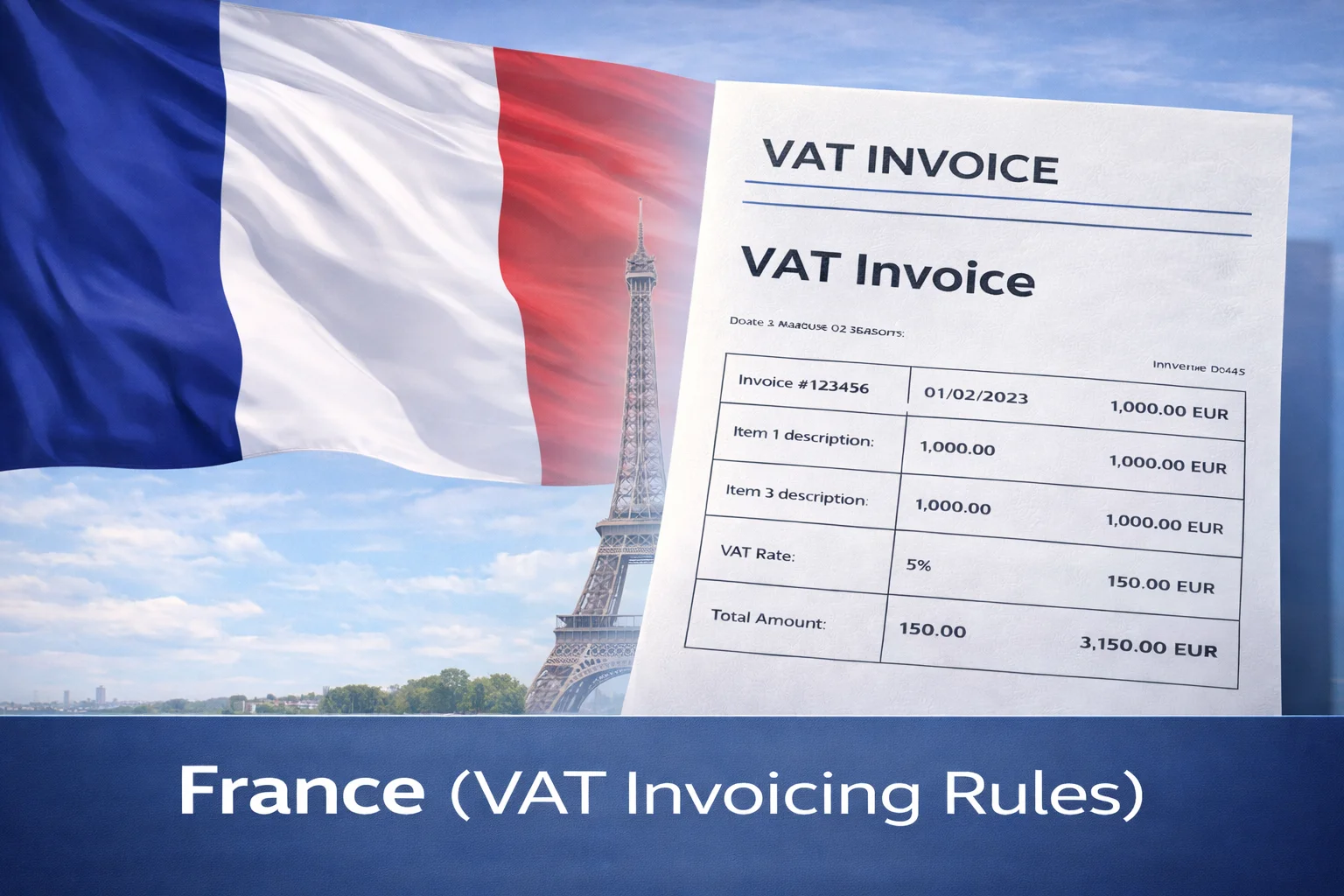
France (VAT Invoicing Rules)
France operates one of the most detailed and compliance-focused VAT systems in the European Union. Invoicing rules in France are governed by national tax legislation while remaining aligned with EU VAT directives. Businesses operating in France or supplying goods and services to French customers must comply with strict invoicing and documentation requirements.
French tax authorities rely heavily on invoices as primary evidence for VAT reporting, deductions, and audits. Invoices must be accurate, complete, and traceable. Errors or omissions can lead to denied VAT recovery, penalties, or increased scrutiny.
This guide explains French VAT invoicing rules in detail, covering mandatory invoice content, VAT rates, electronic invoicing, cross-border transactions, record retention, and best practices for businesses targeting the French market.
Understanding and applying French-compliant invoicing practices helps businesses reduce tax risk, improve payment reliability, and operate confidently in one of Europe’s largest consumer markets.
Legal Framework for Invoicing in France
French invoicing requirements are established under national tax law and commercial regulations, which implement EU VAT directives into domestic legislation. These rules apply to VAT-registered businesses and, in certain cases, to non-resident suppliers.
Invoices serve as legal and fiscal documents used to justify VAT charges, deductions, and revenue recognition. French authorities require invoices to meet strict content and formatting standards.
Non-compliant invoices may be rejected during audits, leading to financial and administrative consequences.
When Is a VAT Invoice Required in France?
A VAT invoice is required for taxable supplies of goods or services made by VAT-registered businesses in France. This applies to domestic sales and many cross-border transactions.
Invoices must generally be issued within a prescribed timeframe after the supply is made. Timely invoicing is essential for correct VAT reporting.
For certain retail or low-value transactions, simplified invoices may be permitted.
Mandatory Information on a French VAT Invoice
A valid French VAT invoice must include the supplier’s full legal business name, registered address, and VAT identification number.
The invoice must show a unique invoice number, date of issue, and date of supply if different. A clear and detailed description of the goods or services supplied is required.
The applicable VAT rate, VAT amount, and total amount payable before and after VAT must be clearly displayed. Any discounts or rebates must be shown separately.
Simplified VAT Invoices in France
Simplified VAT invoices are allowed for low-value transactions. These invoices contain fewer details but must still identify the supplier and VAT amount.
Simplified invoices are commonly used in retail, hospitality, and transport services.
Businesses must ensure simplified invoices are used only where legally permitted.
French VAT Rates and Invoice Presentation
France applies multiple VAT rates, including a standard rate and reduced rates for specific goods and services. Invoices must clearly indicate which VAT rate applies.
For VAT-exempt or zero-rated supplies, invoices must reference the applicable exemption.
Clear VAT presentation supports transparency and compliance.
VAT-Registered vs Non-Registered Businesses
Only VAT-registered businesses may charge VAT and issue VAT invoices in France. Non-registered businesses must not charge VAT.
Invoices issued by non-registered businesses should clearly state that VAT is not applicable.
Clear differentiation prevents compliance errors and customer confusion.
Invoicing for Freelancers and Self-Employed Professionals
Freelancers and self-employed professionals in France rely on invoices to document income and VAT obligations.
If registered for VAT, invoices must meet all VAT invoice requirements. Small business VAT exemptions may apply in certain cases.
Clear descriptions, service periods, and VAT treatment help reduce disputes.
Contractors and Professional Services Invoicing
Consultants and contractors typically invoice based on time, milestones, or deliverables.
Invoices must align with contractual agreements and accurately reflect services provided.
Accurate invoicing supports tax reviews and financial clarity.
Cross-Border Invoicing and EU Transactions
Cross-border supplies within the EU may involve zero-rated VAT or reverse charge mechanisms.
Invoices must include both supplier and customer VAT identification numbers.
Clear documentation is essential to support VAT exemptions and avoid penalties.
Reverse Charge Mechanism in France
The reverse charge mechanism applies to certain domestic and cross-border transactions, shifting VAT responsibility to the customer.
Invoices subject to reverse charge must clearly state that the reverse charge applies and reference the relevant legal basis.
Correct application reduces compliance risk.
Invoicing for Digital Services and E-Commerce
Digital services and online sales are subject to specific VAT rules in France.
Invoices must reflect correct VAT treatment based on customer location and service type.
Automated invoicing systems help manage VAT complexity.
Foreign Currency Invoices
Invoices may be issued in foreign currencies. VAT amounts must be converted to euros using approved exchange rates.
Invoices should document currency and conversion methodology.
Accurate conversion supports VAT reporting and reconciliation.
Electronic Invoicing and Digital Records
Electronic invoicing is permitted in France provided authenticity, integrity, and readability are ensured.
Digital invoices must contain the same mandatory information as paper invoices.
Electronic storage improves efficiency and audit readiness.
Invoice Numbering and Traceability
Invoices must have unique identifiers to ensure traceability.
Sequential numbering supports audit trails and compliance reviews.
Automated systems help maintain numbering accuracy.
Credit Notes and VAT Adjustments
Credit notes must be issued for refunds, cancellations, or invoice corrections.
These documents must reference the original invoice and specify VAT adjustments.
Proper issuance supports accurate VAT reporting.
Invoice Retention and Record-Keeping Requirements
French law requires invoices and tax records to be retained for the legally prescribed period.
Records must be accessible and readable for tax authorities.
Digital storage is permitted if compliance standards are met.
Industry-Specific Invoicing Practices
Construction, professional services, retail, and e-commerce sectors apply invoicing differently.
Industry-specific practices must still comply with VAT law.
Clear invoicing improves transparency and compliance.
Common Invoicing Mistakes in France
Common mistakes include missing VAT numbers, incorrect VAT rates, and incomplete invoice details.
Errors may result in denied VAT deductions or penalties.
Regular invoice reviews help prevent compliance issues.
Frequently Asked Questions About French VAT Invoicing
Businesses often ask whether electronic invoices are accepted. Electronic invoicing is permitted under French law.
Another common question concerns invoice language. Invoices must be understandable to tax authorities.
Invoices are a central focus during VAT audits.
Final Thoughts on French VAT-Compliant Invoicing
French VAT-compliant invoicing is essential for businesses operating in or supplying to France.
Accurate invoices support VAT recovery, audits, and financial transparency.
By adopting compliant invoicing systems, businesses can confidently meet French tax requirements while focusing on growth.