Singapore GST Invoicing Rules
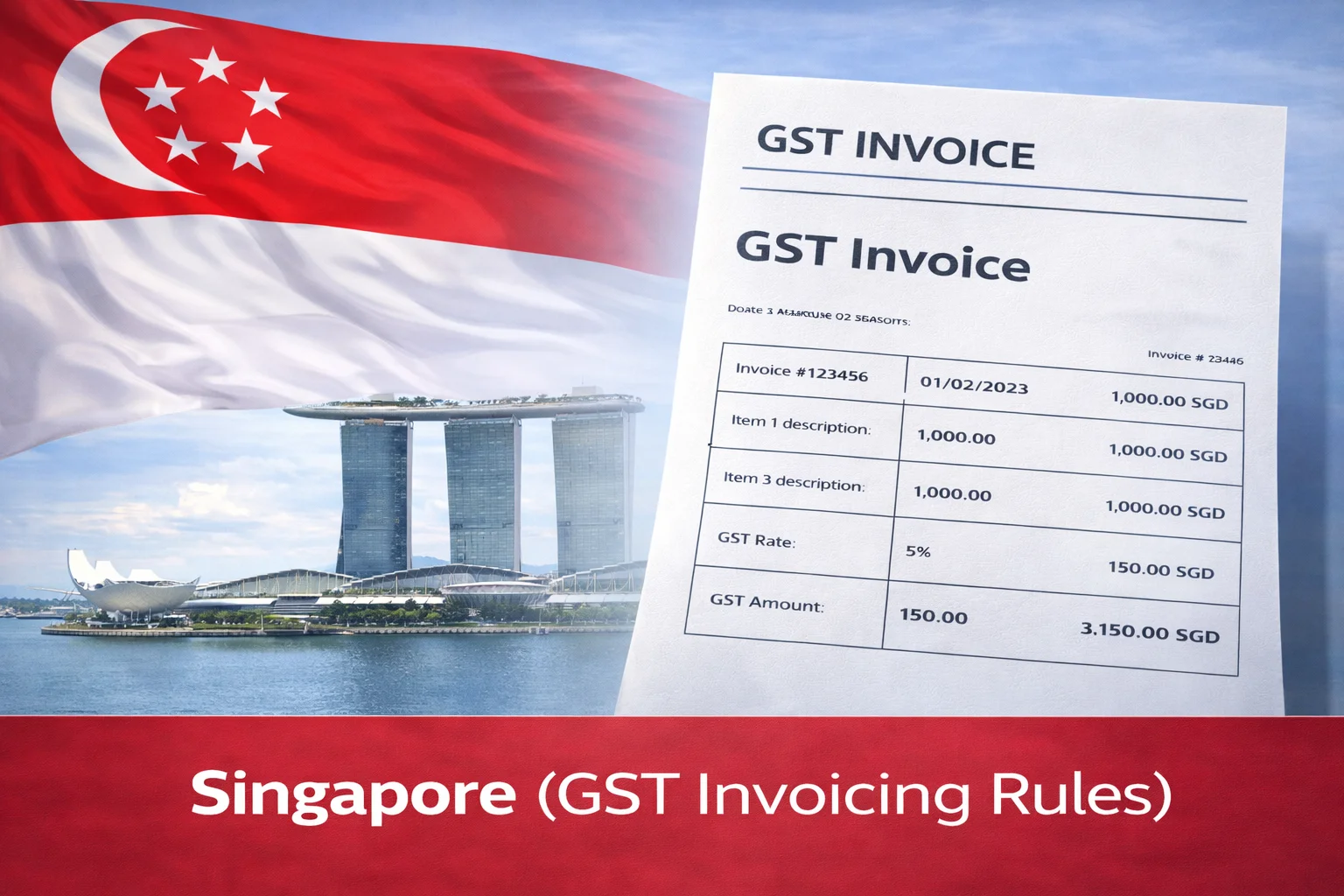
Singapore (GST Invoicing Rules)
Singapore operates a highly structured and business-friendly Goods and Services Tax (GST) system administered by the Inland Revenue Authority of Singapore (IRAS). Invoicing rules in Singapore are closely linked to GST compliance, record-keeping, and audit requirements.
Businesses operating in Singapore or supplying goods or services to Singapore customers must ensure invoices accurately reflect GST treatment. Proper invoicing supports GST reporting, reduces audit risk, and enhances transparency for customers and tax authorities.
This guide explains Singapore GST invoicing rules in detail, including tax invoice requirements, simplified invoices, GST registration implications, cross-border transactions, electronic invoicing, and best practices for businesses targeting the Singapore market.
Understanding and applying IRAS-compliant invoicing practices helps businesses maintain compliance while operating in one of Asia’s most important financial and commercial hubs.
Overview of GST in Singapore
GST in Singapore is a broad-based consumption tax applied to most goods and services supplied locally, as well as imports.
Businesses registered for GST are required to charge GST on taxable supplies and report this tax to IRAS.
Invoices play a central role in documenting GST charged and supporting input tax credit claims.
When Is a Tax Invoice Required in Singapore?
A tax invoice is required when a GST-registered business makes a taxable supply. Tax invoices must be issued within the timeframe specified by IRAS.
Customers use tax invoices to support claims for input tax credits. Without a valid tax invoice, GST recovery may be denied.
Non-GST-registered businesses must not issue tax invoices or charge GST.
Mandatory Information on a Singapore GST Tax Invoice
A valid Singapore GST tax invoice must include the supplier’s business name, address, and GST registration number.
The invoice must show a unique invoice number and date of issue. A clear description of the goods or services supplied is required.
The amount of GST charged must be clearly stated, either as a separate line item or by indicating that the price includes GST.
Simplified Tax Invoices in Singapore
Simplified tax invoices are permitted for lower-value transactions. These invoices contain fewer details but must still show the supplier’s identity and GST amount.
Simplified invoices are commonly used in retail and hospitality sectors.
Businesses must ensure simplified invoices are only used where permitted.
GST Rates and Invoice Presentation
Invoices must clearly indicate the GST rate applied. If prices are GST-inclusive, the invoice should clearly state this.
For zero-rated or exempt supplies, invoices must indicate the applicable GST treatment.
Clear presentation supports transparency and accurate reporting.
GST-Registered vs Non-Registered Businesses
Only GST-registered businesses may charge GST and issue GST tax invoices.
Non-registered businesses should issue standard invoices without GST.
Clear distinction helps prevent compliance errors.
Invoicing for Freelancers and Small Businesses
Freelancers and small businesses in Singapore rely on invoices to document income and GST obligations.
If registered for GST, invoices must meet all tax invoice requirements. If not registered, GST must not be charged.
Clear service descriptions and payment terms help reduce disputes.
Voluntary GST Registration and Invoicing
Some businesses voluntarily register for GST even if they do not meet mandatory thresholds.
Once registered, businesses must issue GST tax invoices and comply with all GST invoicing rules.
Accurate invoicing is essential to maintain registration compliance.
Invoicing for Cross-Border and International Transactions
Supplies involving overseas customers may be zero-rated depending on the nature of the transaction.
Invoices must clearly state when GST is zero-rated and reference the applicable treatment.
International suppliers to Singapore customers may have GST registration obligations depending on supply type.
Foreign Currency Invoices
Invoices may be issued in foreign currencies. GST amounts must be converted to Singapore dollars using approved exchange rates.
Invoices should document the currency used and conversion method.
Accurate conversion supports GST reporting.
Electronic Invoicing and Digital Records
IRAS permits electronic invoicing provided authenticity, integrity, and accessibility are maintained.
Digital invoices must contain the same information as paper invoices.
Electronic record-keeping improves efficiency and audit readiness.
Invoice Numbering and Internal Controls
Invoices should have unique identifiers to support traceability.
Sequential numbering helps demonstrate completeness of records.
Automated invoicing systems reduce errors.
Credit Notes and GST Adjustments
Credit notes must be issued for refunds, cancellations, or corrections.
These documents must reference the original invoice and specify GST adjustments.
Proper documentation supports accurate GST reporting.
Payment Terms and Late Payments
Invoices should clearly state payment terms, due dates, and accepted payment methods.
Clear payment information improves cash flow and reduces disputes.
Consistent enforcement supports financial stability.
Record Retention Requirements in Singapore
Businesses must retain invoices and GST records for the period required by IRAS.
Records must be accessible and readable upon request.
Digital records are permitted if properly maintained.
Industry-Specific Invoicing Practices
Professional services, logistics, retail, and e-commerce sectors apply invoicing differently.
Industry practices must still comply with GST rules.
Clear invoicing improves compliance and customer understanding.
Common Invoicing Mistakes in Singapore
Common mistakes include charging GST without registration, missing GST numbers, and unclear tax presentation.
Errors can lead to penalties or denied input tax claims.
Regular invoice reviews help prevent compliance issues.
Frequently Asked Questions About Singapore GST Invoicing
Businesses often ask whether electronic invoices are acceptable. Electronic invoicing is permitted under IRAS rules.
Another common question concerns invoice language. Invoices must be understandable for tax authorities.
Invoices are key documents during GST audits.
Final Thoughts on Singapore GST-Compliant Invoicing
Singapore GST-compliant invoicing is essential for businesses operating in or supplying to Singapore.
Accurate invoices support GST reporting, audits, and financial transparency.
By adopting compliant invoicing systems, businesses can confidently meet IRAS requirements while focusing on growth.