Saudi Arabia E-Invoicing Rules
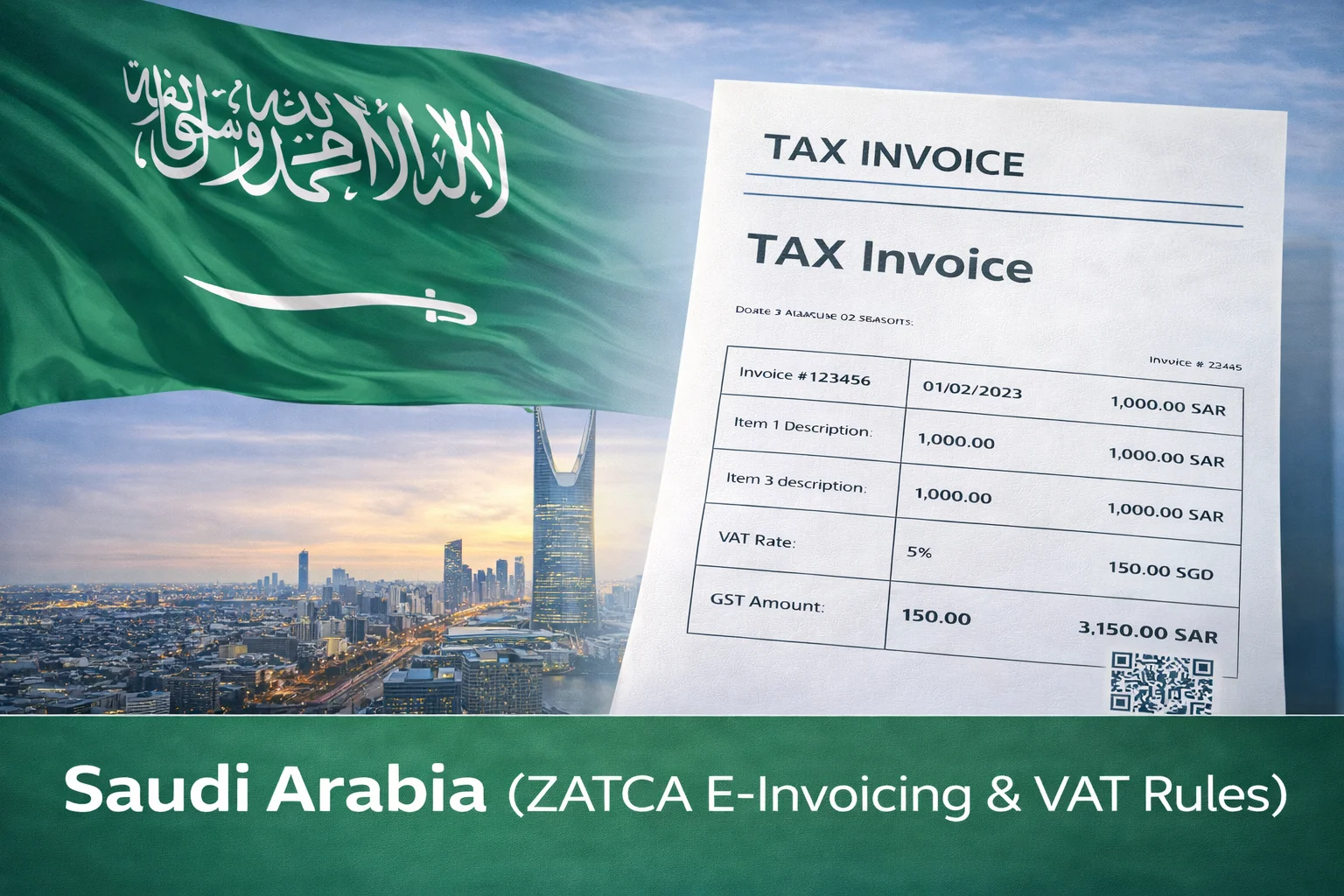
Saudi Arabia (ZATCA E-Invoicing & VAT Rules)
Saudi Arabia operates one of the most advanced and strictly regulated VAT and electronic invoicing systems in the world. Invoicing rules are administered by the Zakat, Tax and Customs Authority (ZATCA) and are closely integrated with mandatory electronic invoicing requirements.
Businesses operating in Saudi Arabia or supplying goods or services to Saudi customers must comply with VAT regulations and ZATCA’s e-invoicing framework. Invoices are not only financial documents but also regulated digital records subject to real-time or near real-time compliance controls.
This guide explains Saudi Arabia’s VAT invoicing and e-invoicing requirements in detail, including mandatory invoice elements, electronic invoice phases, simplified invoices, cross-border transactions, record retention, and best practices for businesses operating in the Kingdom.
Understanding and applying ZATCA-compliant invoicing practices is essential for avoiding penalties, maintaining tax compliance, and operating confidently in Saudi Arabia’s regulated business environment.
Overview of VAT in Saudi Arabia
Saudi Arabia applies VAT to most supplies of goods and services at the standard rate, with certain supplies classified as zero-rated or exempt.
VAT-registered businesses are required to charge VAT on taxable supplies and report this tax to ZATCA through periodic VAT returns.
Invoices form the foundation of VAT reporting, audits, and input tax recovery.
Introduction to ZATCA E-Invoicing (FATOORA)
Saudi Arabia introduced mandatory electronic invoicing under the FATOORA initiative to enhance transparency, reduce tax evasion, and modernise tax administration.
E-invoicing applies to VAT-registered persons and requires invoices to be generated, stored, and shared electronically in a prescribed format.
Manual or handwritten invoices are not permitted for transactions subject to e-invoicing rules.
Phases of Saudi Arabia E-Invoicing
ZATCA implemented e-invoicing in multiple phases. The initial phase focuses on generating and storing electronic invoices with required fields and QR codes.
Subsequent phases involve system integration with ZATCA platforms for invoice reporting or clearance.
Businesses must ensure their invoicing systems comply with the applicable phase requirements.
When Is a Tax Invoice Required in Saudi Arabia?
A tax invoice is required when a VAT-registered business makes a taxable supply.
The invoice must be issued within the timeframe specified by VAT regulations and generated through a compliant electronic system.
Customers use tax invoices to support input VAT recovery.
Mandatory Information on a Saudi VAT Tax Invoice
A valid Saudi VAT tax invoice must include the supplier’s legal business name, address, and VAT registration number.
The invoice must display a unique invoice number, date of issue, and date of supply if different.
A clear description of goods or services supplied is required, along with quantity where applicable.
The VAT rate applied and VAT amount charged must be clearly shown.
Simplified Tax Invoices in Saudi Arabia
Simplified tax invoices may be used for low-value transactions, particularly in retail environments.
These invoices contain fewer details but must still comply with ZATCA e-invoicing requirements.
Simplified invoices must include a QR code containing mandatory invoice data.
VAT Rates and Invoice Presentation
Invoices must clearly indicate whether VAT is charged at the standard rate, zero-rated, or exempt.
For zero-rated or exempt supplies, invoices must clearly state the applicable VAT treatment.
Clear presentation supports compliance and accurate VAT reporting.
VAT-Registered vs Non-Registered Businesses
Only VAT-registered businesses may charge VAT and issue VAT tax invoices.
Non-registered businesses must not charge VAT or issue tax invoices.
Clear differentiation prevents compliance breaches.
Invoicing for Small Businesses and Freelancers
Small businesses and freelancers in Saudi Arabia must comply with VAT and e-invoicing rules if registered.
Invoices must be generated electronically and include all mandatory fields.
Accurate invoicing supports compliance and audit readiness.
Invoicing for Cross-Border and International Transactions
Cross-border supplies may be zero-rated depending on the nature of the transaction.
Invoices must clearly indicate when VAT is zero-rated and reference applicable provisions.
International suppliers may have VAT registration obligations depending on their activities.
Reverse Charge Mechanism in Saudi Arabia
The reverse charge mechanism applies to certain imports of services and goods.
Invoices subject to reverse charge must clearly state that VAT is accounted for by the customer.
Correct application supports compliance and accurate VAT reporting.
Foreign Currency Invoices
Invoices may be issued in foreign currencies, but VAT amounts must be converted to Saudi riyals.
Invoices should document currency used and conversion methodology.
Accurate conversion supports VAT reporting.
Electronic Invoicing System Requirements
E-invoicing systems must meet ZATCA technical and security requirements.
Invoices must be stored electronically and protected against tampering.
Compliance-ready systems reduce risk of penalties.
Invoice Numbering and Traceability
Invoices must have unique identifiers generated by compliant systems.
Sequential numbering supports traceability and audit trails.
Automated systems ensure consistency.
Credit Notes and VAT Adjustments
Credit notes must be issued electronically for refunds or invoice corrections.
These documents must reference the original invoice and show VAT adjustments.
Proper issuance supports accurate VAT reporting.
Payment Terms and Invoice Clarity
Invoices should clearly state payment terms, due dates, and payment methods.
Clear payment information improves cash flow and reduces disputes.
Consistency supports financial stability.
Record Retention Requirements in Saudi Arabia
Businesses must retain electronic invoices and VAT records for the period specified by ZATCA.
Records must be accessible and readable upon request.
Secure digital storage is mandatory.
Industry-Specific Invoicing Practices
Retail, construction, logistics, professional services, and e-commerce sectors apply invoicing differently.
Industry practices must still comply with VAT and e-invoicing rules.
Clear invoicing improves compliance and transparency.
Common Invoicing Mistakes in Saudi Arabia
Common mistakes include issuing manual invoices, missing QR codes, and non-compliant systems.
Errors can lead to penalties or system enforcement actions.
Regular system reviews help maintain compliance.
Frequently Asked Questions About Saudi E-Invoicing
Businesses often ask whether paper invoices are allowed. Paper invoices are not permitted where e-invoicing applies.
Another common question concerns system integration timelines. Businesses must comply with ZATCA deadlines.
E-invoices are central to VAT audits.
Final Thoughts on ZATCA-Compliant Invoicing
Saudi Arabia’s VAT and e-invoicing system is among the most advanced globally.
Accurate, compliant electronic invoicing is essential for operating in the Kingdom.
By adopting ZATCA-compliant invoicing systems, businesses can confidently meet regulatory requirements while focusing on growth.