HMRC VAT Invoicing Rules
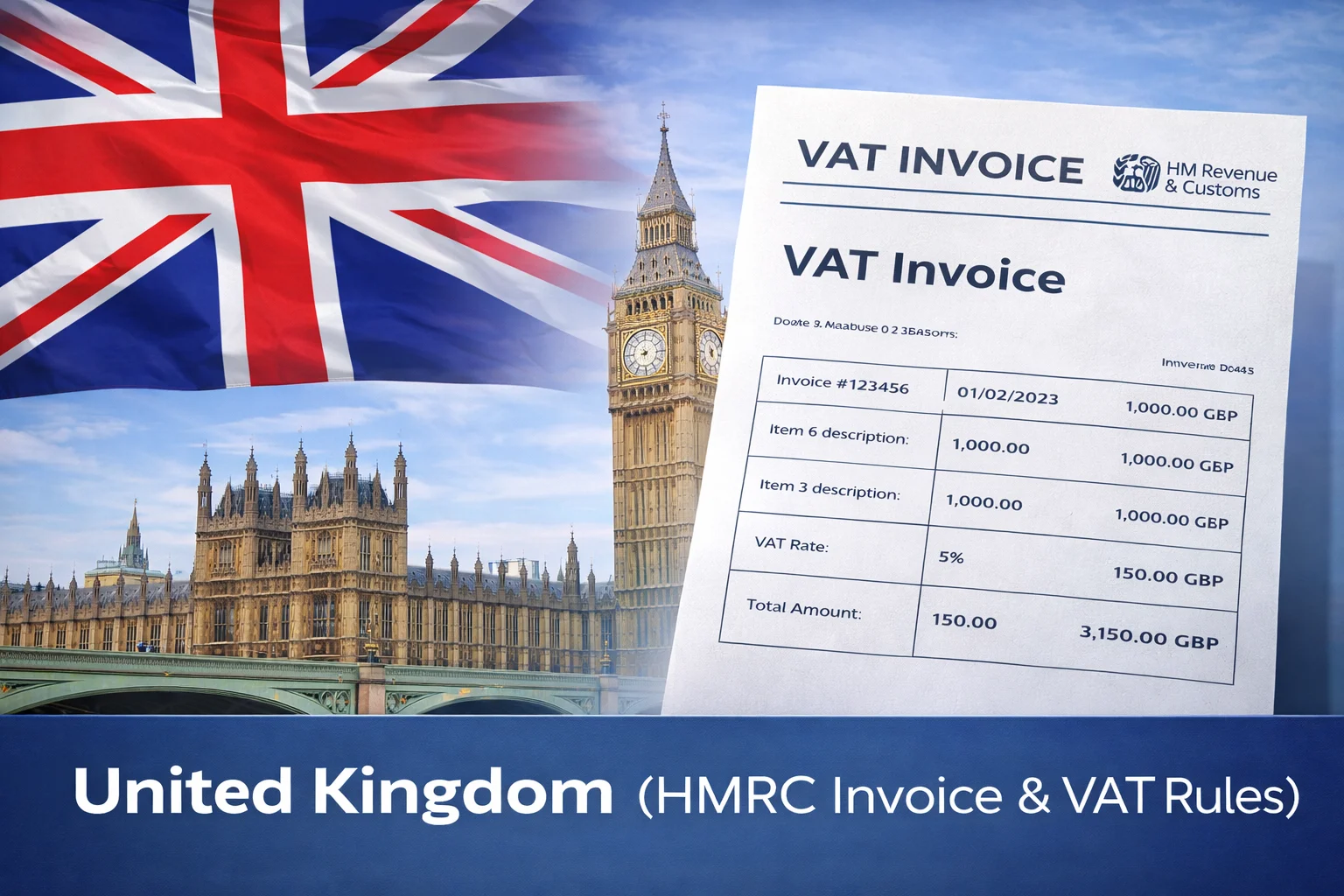
United Kingdom (HMRC Invoice & VAT Rules)
In the United Kingdom, invoicing rules are closely linked to tax compliance, value added tax (VAT) reporting, and record-keeping obligations regulated by His Majesty’s Revenue and Customs (HMRC). Whether you are a UK-based business, sole trader, contractor, or an international company supplying goods or services to UK customers, understanding HMRC invoicing requirements is essential for lawful operation and financial accuracy.
Invoices in the UK serve as formal evidence of sales, expenses, and VAT obligations. While HMRC does not impose a single mandatory invoice template, businesses must ensure invoices include specific information when VAT is involved. Correct invoicing supports VAT returns, reduces audit risk, and improves transparency for both suppliers and customers.
This guide explains UK invoicing and VAT rules in detail, covering VAT invoices, simplified invoices, international supplies, digital record-keeping, industry-specific practices, and best-practice compliance for businesses operating in or supplying to the UK.
Whether you are issuing invoices domestically or internationally, understanding HMRC requirements helps ensure compliance, improves payment reliability, and supports long-term business growth.
Are Invoices Legally Required in the UK?
In the UK, invoices are not legally required for every transaction. However, businesses must maintain accurate records of income and expenses for tax purposes. When VAT is charged, a VAT invoice becomes a critical compliance document.
VAT-registered businesses must issue VAT invoices to customers for taxable supplies, except in limited circumstances such as retail transactions where simplified invoices may apply.
Invoices support accounting records, VAT returns, and audit trails. Without proper invoicing, businesses may struggle to substantiate income or VAT treatment during HMRC reviews.
What Is a VAT Invoice Under UK Law?
A VAT invoice is a document issued by a VAT-registered business that records the details of a taxable supply. It allows the customer to reclaim VAT (if eligible) and enables the supplier to report VAT accurately.
VAT invoices can be issued electronically or in paper form. HMRC does not require prior approval for electronic invoices, provided authenticity and integrity are maintained.
VAT invoices must be issued within a specified timeframe after the supply, depending on the type of transaction.
Mandatory Information on a UK VAT Invoice
A valid UK VAT invoice must include specific information prescribed by HMRC. This includes the supplier’s legal business name, address, and VAT registration number.
The invoice must display a unique invoice number, the date of issue, and the tax point (if different). It should describe the goods or services supplied in sufficient detail.
The VAT rate applied, the amount of VAT charged, and the total amount payable excluding and including VAT must be clearly shown. If different VAT rates apply, they must be itemised separately.
Simplified VAT Invoices
HMRC allows simplified VAT invoices for low-value transactions. These invoices contain fewer details but must still identify the supplier, show the VAT rate, and include the total amount including VAT.
Simplified invoices are common in retail, hospitality, and transport services. They reduce administrative burden while maintaining compliance.
Businesses must ensure simplified invoices are only used where permitted and that standard invoices are issued when required.
VAT Rates and Invoice Presentation
The UK applies multiple VAT rates depending on the type of goods or services supplied. Invoices must clearly show which VAT rate applies to each item.
For zero-rated or exempt supplies, invoices should clearly state the VAT treatment and reference the applicable exemption or zero-rating.
Accurate VAT presentation reduces customer confusion and supports correct VAT reporting.
Invoicing for VAT-Registered vs Non-Registered Businesses
Only VAT-registered businesses may issue VAT invoices and charge VAT. Non-registered businesses must not charge VAT or label invoices as VAT invoices.
Non-registered businesses may still issue standard invoices for record-keeping and payment purposes.
Clear distinction between VAT and non-VAT invoices is essential to avoid compliance breaches.
Invoices for Freelancers and Sole Traders
Freelancers and sole traders in the UK frequently rely on invoices to document income and support self-assessment tax returns.
If VAT-registered, freelancers must issue VAT invoices that meet HMRC requirements. If not registered, invoices should clearly indicate that VAT is not charged.
Clear service descriptions, dates, and payment terms help reduce disputes and support timely payments.
Contractors and IR35 Considerations
Contractors working through personal service companies or as self-employed individuals must ensure invoices accurately reflect contractual arrangements.
Invoices should align with contracts to support IR35 assessments and tax classification.
Accurate invoicing helps reduce disputes and supports compliance reviews.
International Invoicing and Cross-Border VAT
UK invoicing rules vary depending on whether supplies are domestic or cross-border. International transactions may involve reverse charge mechanisms or zero-rated VAT.
Invoices for international supplies should clearly state the VAT treatment applied and reference any applicable reverse charge provisions.
Clear documentation supports compliance and reduces confusion for overseas customers.
Foreign Currency Invoices
UK businesses may issue invoices in foreign currencies. However, VAT amounts must be converted to pounds sterling using HMRC-approved exchange rates.
Invoices should document the currency used and the conversion method applied.
Accurate currency handling supports correct VAT reporting and reconciliation.
Invoice Numbering and Record Integrity
Invoices should follow a logical numbering sequence. While HMRC does not mandate a specific format, uniqueness and consistency are essential.
Sequential numbering supports audit trails and simplifies record-keeping.
Automated invoicing systems help maintain numbering accuracy.
Credit Notes and VAT Adjustments
When correcting errors or issuing refunds, businesses must issue VAT credit notes. These documents must reference the original invoice and specify the VAT adjustment.
Credit notes are essential for correcting VAT returns and maintaining accurate records.
Clear documentation reduces disputes and audit risk.
Late Payment Terms and Invoice Clarity
UK invoices commonly include payment terms such as net payment periods. Clear terms improve cash flow and reduce disputes.
Invoices may reference statutory late payment interest where applicable.
Transparency in payment conditions supports professional relationships.
Digital Invoicing and Making Tax Digital (MTD)
HMRC encourages digital record-keeping under the Making Tax Digital initiative. Many businesses now issue and store invoices electronically.
Digital invoices must meet the same information standards as paper invoices.
Electronic record-keeping improves accuracy and compliance efficiency.
Invoice Retention and Record-Keeping Requirements
Businesses must retain invoices and VAT records for the period specified by HMRC. Records must be accessible and readable.
Digital storage is permitted provided records remain secure.
Proper retention supports audits and long-term financial planning.
Industry-Specific Invoicing Practices
Different industries apply invoicing differently. Construction businesses may issue staged invoices, while professional services often bill based on time or milestones.
E-commerce businesses must ensure VAT treatment is clearly reflected on invoices.
Industry-aligned invoicing improves clarity and compliance.
Common Invoicing Mistakes to Avoid
Common mistakes include missing VAT numbers, incorrect VAT rates, and unclear descriptions.
Failing to issue credit notes for adjustments can lead to incorrect VAT reporting.
Regular reviews help prevent compliance issues.
Frequently Asked Questions About UK Invoicing
Many businesses ask whether electronic invoices are allowed. HMRC permits electronic invoicing without prior approval.
Another common question concerns invoice language. Invoices should be clear and understandable for UK tax purposes.
Businesses also ask how invoices support VAT audits. Invoices are core evidence during HMRC reviews.
Final Thoughts on HMRC-Compliant Invoicing
HMRC-compliant invoicing is essential for businesses operating in or supplying to the UK. Clear, accurate invoices support VAT reporting, audits, and financial transparency.
For international businesses, understanding UK invoicing rules builds trust and simplifies cross-border trade.
By adopting compliant invoicing practices and digital systems, businesses can confidently meet HMRC expectations while focusing on growth.